
FCC Providers
Federal Communications Commission
Licenses
Element 1: Basic radio law and operating practice with which every maritime radio operator should be familiar. MPs are required to operate radiotelephone stations aboard certain vessels that sail the Great Lakes. They are also required to operate radiotelephone stations aboard vessels of more than 300 gross tons and vessels which carry more than six passengers for hire in the open sea or any tidewater area of the United States. They are also required to operate certain aviation radiotelephone stations and certain coast radiotelephone stations.
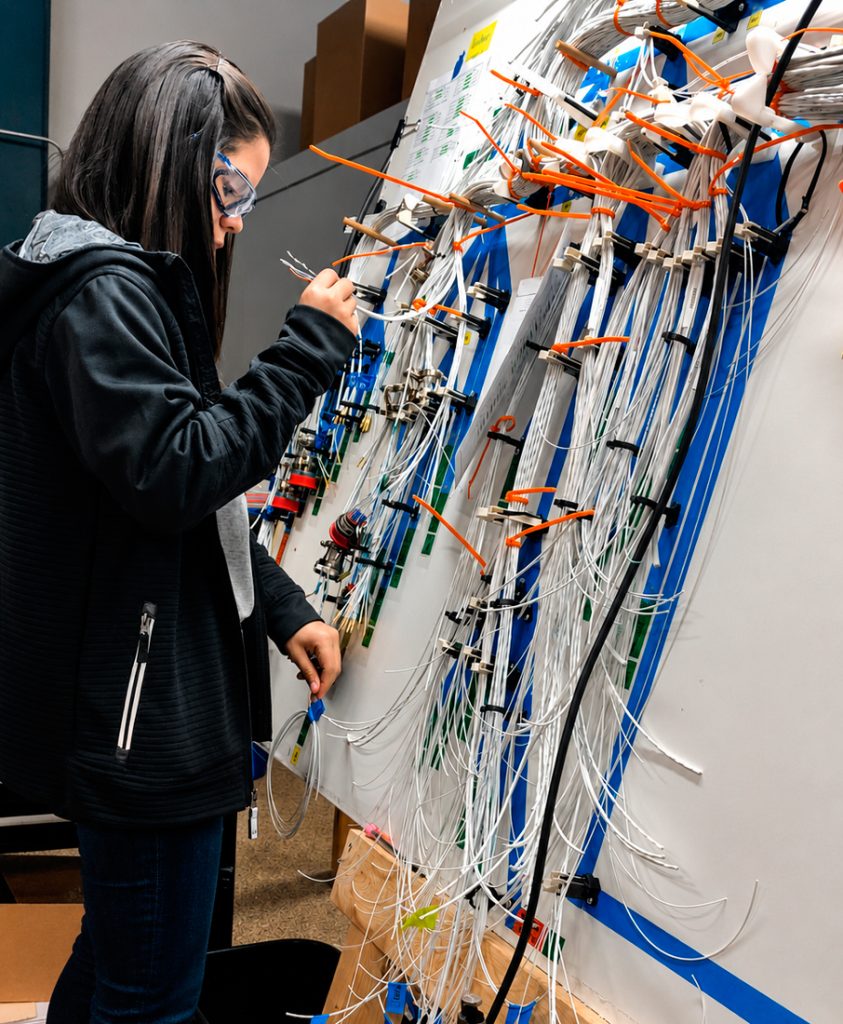
This program provides practical training in the installation, inspection, troubleshooting, and maintenance of aircraft electronic systems used for navigation, communication, and flight
operations. Students learn using industry-standard tools and equipment while developing the technical skills employers are looking for.
Sign up for
Our mailing list
Program
Schedule

Element 3
General Radiotelephone
Electronic fundamentals and techniques required to adjust, repair, and maintain radio transmitters and receivers:
Aircraft electrical and electronic systems
Monday/Wednesday (9am – 12pm):
3 hour session; six (6) hours per week for 12 weeks.
Tuesday/Thursday (9am – 12pm):
3 hour session; six (6) hours per week for 12 weeks.
Navigation and communication equipment
3 hour session; six (6) hours per week for 12 weeks
Tueday/Thursday (6pm – 9pm):
3 hour session; six (6) hours per week for 12 weeks
Avionics installation and troubleshooting
6 hour session; (once) every Saturday for 12 weeks
Aviation safety and regulatory compliance
Monday/Wednesday (9am – 12pm):
3 hour session; six (6) hours per week for 12 weeks.
Tuesday/Thursday (9am – 12pm):
3 hour session; six (6) hours per week for 12 weeks.
Quality control and inspection procedures
3 hour session; six (6) hours per week for 12 weeks
Tueday/Thursday (6pm – 9pm):
3 hour session; six (6) hours per week for 12 weeks
Technical documentation and industry standards
Saturday (9am-4pm):
6 hour session; (once) every Saturday for 12 weeks
- Operating Procedures
- Radio Practice
- Circuit Components
- Signals and Emissions
- Radio Wave Propagation
- Electrical Principles
- Practical Circuits
- Antennas and Feed Lines

A PG is required to adjust, maintain, or internally repair FCC licensed radiotelephone
transmitters in the aviation, maritime, and international fixed public radio services. It conveys all of the operating authority of the MP. It is also required to operate the following:
- Any compulsorily equipped ship radiotelephone station operating with more than 1500 watts of peak envelope power.
- Voluntarily equipped ship and aeronautical (including aircraft) stations with more than 1000 watts of peak envelope power.
Element 8
Ship Radar Techniques
Specialized theory and practice applicable to the proper
installation, servicing, and maintenance of ship radar equipment in general use for marine
navigation purposes. Only persons whose commercial radio operator license bears this
endorsement may repair, maintain, or internally adjust ship radar equipment.
- Interpretar diagramas y planos eléctricos (Blueprints).
- Comprender el funcionamiento de los sistemas eléctricos, electrónicos, de navegación y comunicación de las aeronaves.
- Realizar instalaciones, inspecciones, diagnóstico y solución de fallas en equipos de aviónica.
- Aplicar procedimientos de mantenimiento siguiendo las regulaciones y mejores prácticas de la industria.
Element 9
GMDSS Radio Maintenance Practices and Procedures
Requirements set forth in IMO Assembly on Training for Radio Personnel (GMDSS), Annex 5 and IMO Assembly on Radio Maintenance Guidelines for the Global Maritime Distress and Safety System related to Sea Areas A3 and A4. The exam consists of questions from the following categories: radio system theory, amplifiers, power sources, troubleshooting, digital theory, and GMDSS equipment and regulations. The DM qualifies personnel as GMDSS radio maintainers to perform at sea repair and maintenance of GMDSS equipment. It also confers the operating authority of the PG and MP.
- Interpretar diagramas y planos eléctricos (Blueprints).
- Comprender el funcionamiento de los sistemas eléctricos, electrónicos, de navegación y comunicación de las aeronaves.
- Realizar instalaciones, inspecciones, diagnóstico y solución de fallas en equipos de aviónica.
- Aplicar procedimientos de mantenimiento siguiendo las regulaciones y mejores prácticas de la industria.
Week 1
- Introduction Instructor & Students
- Expectations of the course and classroom rules & safety
- Explanation of student package
- Types of airplanes & categories (General Aviation, Corporate Airplanes, Commercial Aviation)
- Parts of the airplane ( Rudder, Flaps, Elevator, Etc.)
- Gyroscopic Instruments (Heading Indicator, Attitude Indicator, Turn Coordinator)
- Vacuum System
- Pitot Static System (Airspeed Indicator, Vertical Sped, Altimeter)
- ADS-B (Automatic Dependent Surveillance-Broadcast)
- VOR (VHF Omnidirectional Range)
- DME (Distance Measuring Equipment)
- NDB & ADF (Non-directional Radio Beacon & Automatic Direction Finder)
- Radios, COMM, Audio Panel, Navigation
- Antennas
Week 2
- GPS (Global Positioning System)
- WAAS (Wide Area Augmentation System)
- Transponders (Mode A, Mode C, Mode S)
- ELT ( Emergency Locator Transmitter)
- ATC (Air Traffic Control)
- EFIS (Electronic Flight Instrument System)
- PFD (Primary Flight Display)
- MFD / ND (Multi-function Display / Navigation Display)
- TCAS (Traffic Collision and Avoidance System)
- Bus Bar (Aircraft Electrical System Components)
- Human Factors
- General Review
- Assessment
Week 3
- Pitot Static Test / System Diagram / System Error / Barfield 1811D Tester
- Terminals & Connectors
- D-Sub
- Molex
- Circular Connectors
- Connector Design & Usage
- Coax Cable
- BNC Connectors
- TNC Connectors
- Quadrax Connectors familiarization
- Basics of building High Speed Network Cable
- Fiber Optics Introduction
- Basics of building High Speed Network Cable
- Applying Fiber Optics in Aviation
Week 4
- Basic Electronics
- Ohm’s Law
- Series & Parallel Circuit
- Resistors Color Codes
- Alternating Current (AC)
- Direct Current (DC)
- Logic Gates (AND, OR, NOR, XOR)
- Diodes
- Capacitors
- Use of multimeter
- Use of Oscilloscope
- Use of function generator
- Use of power supply
Week 5
- Familiarization of Tools (Hand Tools / Crimp Tools)
- Use of Daniels AFM8, AF8 Crimp Tool
- Go-NO-Go Gauge
- Use of HX3 / HX4 Crimp Tool
- Schematic Symbols
- Soldering Techniques
- Wire Splice
- Soldering Jacks
- Wire Tying Knot
Week #7-12
- Inventory of Wire harness kits
- Schematic familiarization (GMA340 / GTR200 / GTX345)
- Assembly Connectors for GMA340 (Audio Panel)
- Assembly Connectors for GTR200 (Radio)
- Assembly Connectors for GTX345 (Transponder)
- Perform harness ring-out (continuity check)
- Install Harnesses to the Radio, Audio Panel, and Transponder
- Connect ADS-B to iPad for live Air Traffic Surveillance
- Disassembly wire harnesses and inventory kits